
Compare fresh provider-reported windows without merging incompatible limits.
Windows-first alpha Built for real multi-account work
Know where your AI coding runway really is.
Quota Lighthouse turns official provider quota, locally observed activity, freshness, and collector health into one calm decision surface—without pretending they are the same thing.
- Local-firstSQLite WAL, no desktop listener
- Last-goodFailure never becomes invented zero
- ExplainableSource, freshness, health, and caveats
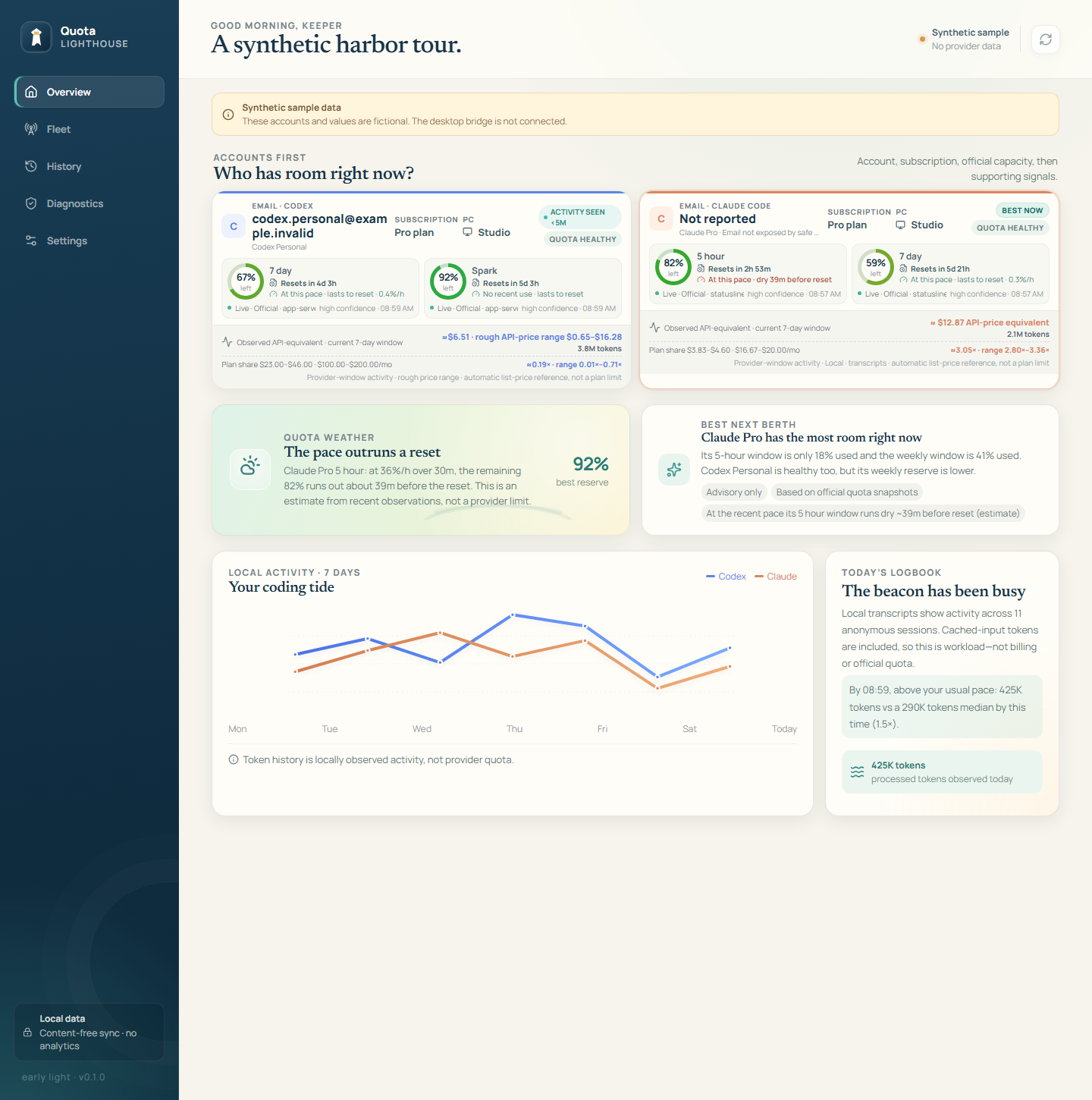
Every useful number keeps observation time, source, confidence, and expiry.
Health history and Fleet liveness turn a missing signal into a bounded next action.
The core promise
Three planes. Never one misleading total.
The product stays useful because it refuses to promote convenient local evidence into provider authority.
Official quota
What the provider says remains.
Rolling windows, reset times, and remaining capacity come only from an official safe surface. These values may answer how much account quota remains.
Codex app-server · Claude statuslineLocal activity
Workload is evidence, not a balance.
Content-free transcript counters help explain today's work, but they never become a quota claim, provider bill, or remaining subscription balance.
Tokens · sessions · machine activityEstimates
Dollar value declares its assumptions.
Current-window account activity receives a dated API-price range and an automatic, same-period subscription-price reference. Ambiguous plans remain ranges; weak quota-percentage proxies never receive a value/price ratio.
Y observed value · X official list-price reference · never a quotaProvider reality
Support means telling the whole truth.
Provider
Current safe surface
What the product claims
Status
OpenAI Codex
Provider-owned app-server read RPC
Official account quota + local activity
Working
Claude Code
Preview-installed statusline + local transcripts
Official observed windows + local activity
Working
Antigravity
CLI presence; quota remains in provider UI
Presence and policy diagnostics only
Boundary
Grok
Token-free route metadata
Presence and policy diagnostics only
Boundary
Consumer OAuth piggybacking, browser-session scraping, undocumented billing probes, and active “test prompts” are deliberately outside the product boundary. Claude setup is an explicit preview-confirmed local settings change with an exact restore path.
How it works
Small trusted steps, visible end to end.
-
1
Collect narrowlyOfficial read surfaces + allowlisted local counters
-
2
Normalize honestlyArbitrary windows, provenance, confidence, freshness
-
3
Keep last-goodSQLite WAL + typed health + refresh-wide scan budgets
-
4
Explain the choiceOne local cockpit; optional signed private Fleet
Production boundary
Useful now. Honest about what is not finished.
Quota Lighthouse is a Windows-first 0.1.x vertical slice. The desktop experience, collectors, adaptive refresh diagnostics, and private Fleet plane are implemented and tested. The application is not yet a signed, installer-backed public release.
- No provider token copies in the Quota Lighthouse database.
- No retained prompt, response, source-code, or project-name storage; a preserved Claude statusline command stays only in private local recovery state.
- No desktop TCP listener; Fleet sync is explicit, signed, and latest-only.
- Claude settings change only after a separate install or restore confirmation.
- No automatic account switching, task routing, or invented quota values.
A calmer signal